
Program Manager, HT Institute
2024 Spring Newsletter
Horticultural Therapy is making an impact on people’s lives.
Read more about how it’s happening.
HTI Director’s Note: More Excitement About IPPS 2024
By Rebecca Haller, HTM

Human Benefits of People Plant Connections
Abstracts have been accepted for oral and poster sessions for the upcoming International People Plant Symposium – an exciting time for anticipating the meetings to come. With a full range of subjects, we will explore the human benefits of people the plant connection on July 11-12 in Reading, England.
Are you interested in how horticulture is being applied for social and therapeutic purposes around the world? Do you want to hear more about gardens and wellness or about gardening prescriptions? How will learning more about various psychological or physical effects of gardening and programming influence your overall program planning and validation? How does our therapeutic use of horticulture intersect with the climate crisis? How will future leaders be recruited? Learn about some aspects of garden design for optimum health. Converse with others around the world to define horticultural therapy and create strong global networks.
These and other thought-provoking and stimulating topics are planned, along with an optional pre-symposium tour on July 10 to see social and therapeutic horticulture sites and wellness gardens. Come along for a few days in England. Be inspired and make connections. To learn more and book your spot, go to https://www.thrive.org.uk/get-involved/events/international-people-plant-symposium-2024.
Note: The Horticultural Therapy Institute is a major sponsor of the symposium because we believe the opportunity to interact with and learn from a global array of speakers and attendees is a worthy endeavor.
Program Profile: If You Build It!
By: Emalyn Leppard
Collaboration to Fruition
*Please note in the original article Amy Zink was referred to as an HTR. This was incorrect and has been correct.
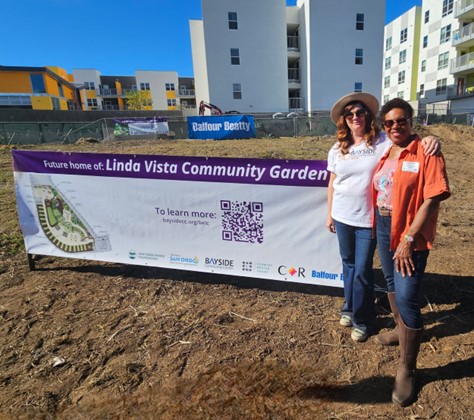
Horticultural therapists, Amy Zink and Emalyn Leppard have collaborated on many garden projects in their community, including three grant funded therapeutic horticulture programs for middle and high school youth coming out of the COVID-19 lockdown (see article on the HTI resource page), however, this one may be the most significant. In addition to addressing issues of food insecurity and food sovereignty, this once blighted area will soon be a beautiful 14,000 sq. ft. space where the two horticultural therapists will provide horticultural therapy and therapeutic horticulture services for local families and for the senior citizens who will reside in the complex being built in the background.
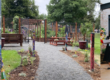
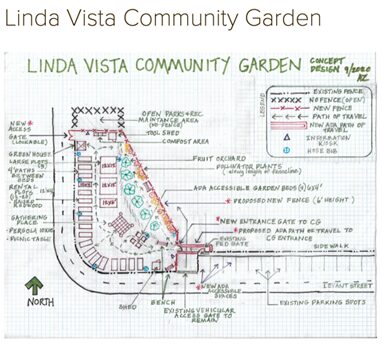
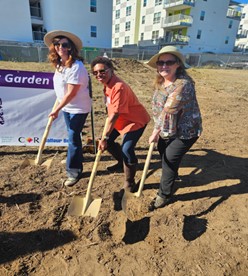
The Linda Vista Community Garden broke ground on Saturday Dec 16, 2023, and will be the first community garden to be built on city park land in the County of San Diego, CA. Amy Zink’s Garden design concept (see below) has been the inspiration all along.
This has been such a long time coming. The original community garden where Zink practiced therapeutic horticulture had to be dismantled when the property was redeveloped. The new state-of-the-art facility is lovely, but city code required a 50 space parking lot! “We made lemonade out of lemons,” says Zink, “by donating as much of the soil and garden materials as possible to smaller local gardens, but unfortunately, all of our community gardeners lost their garden plots.” As Program Manager of Bayside Environmental Learning Center (BELC), (https://www.baysidecc.org/belc) Amy Zink went to work with her local City Councilman, Parks and Rec managers and the San Diego Park Foundation to make sure that the once thriving garden would not be lost forever. Emalyn Leppard remarks “as a member of the steering committee, I am amazed, no I am humbled by her tenacity. All the bureaucratic hoops, the endless red tape, and over seven years of government meetings she endured has come to fruition to make this 14,000 sq. ft dream a reality.”
The new garden will be built as a pro-bono project from the local carpenters’ union and will have 17 12×4 square foot raised beds for rent to community members, four ADA accessible beds and three large production/educational beds. Also include are a native/pollinator garden, fruit trees, potting benches for all generations to use, shade structure for gathering, prefab greenhouse, vermicomposting/composting area, and multiple areas to sit for quiet meditation throughout the garden. Mulch & decomposed granite pathways will meet all ADA requirements and will support opportunities and accessibility for a variety of horticulture therapy activities and classes. Amy and Emalyn agree that “lessons from our Horticultural Therapy Instititute coursework really paid off when it came to designing a space that can meet the needs of ALL of the community. We are really looking forward to bringing multigenerational HT programming into the space, and learning from our amazingly diverse population of neighbors who speak over 13 different language dialects and have so much share.
As the community garden construction is underway, Leppard and Zink are busy writing grants, and brainstorming ideas to combine their skills to support the first horticultural therapy clients that will hopefully be able to start gardening this summer.
For more information regarding the development of this community garden contact [email protected]
Emalyn Leppard, MS, MA is a graduate of the Horticultural Therapy Institute and is a retired special education teacher. She is currently practicing therapeutic horticulture in a specially designed year long program, where university students and middle school students work together in the middle school garden that she built decades ago. Each weekly session begins with a mixture of mindful meditation, grounding and stretching, and a Native American Land Acknowledgment; all before students begin their work in the vegetable garden and fruit orchard.
Tips for Practice: Establishing Authentic Connections with Individuals Impacted by Dementia, Including Alzheimer’s Disease
By Kelly Warnick
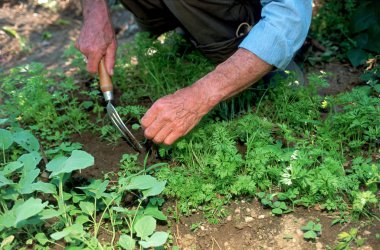
Strategies for how best to meet the needs of the growing older adult population seem to be increasingly “front and center” on many news programs. This heightened concern over the growing older adult population is appreciable.
By 2030, every member of the baby boomer generation will have turned 65 or older, indicating that one-fifth of the American population will be of retirement age. As life expectancy increases alongside the growing elderly population, projections suggest that by 2034, older adults will outnumber children for the first time in American history (Vespa, 2021). As news programs are depicting, it will be vital to ensure effective health condition management for this demographic.
Cases of Dementia Rise within the Expanding Older Adult Population
Also of concern, older adults are increasingly encountering a spectrum of cognitive difficulties, varying from slight decline to moderate dementia, to Alzheimer’s disease. Alzheimer’s is a progressive neurological disorder characterized by memory loss, cognitive decline, and changes in behavior. It is the most common cause of dementia, presently impacting 6.9 million Americans. By 2040, Alzheimer’s cases are predicted to escalate to 11.2 million (Alzheimer’s Association, 2024).
Meeting the Psychosocial Needs of Individuals with Dementia through Horticultural Therapy

Horticultural therapists are keenly aware of how beneficial horticultural therapy (HT) programming is to those living with varying degrees of dementia. Participatory HT activities can enhance cognitive function, encourage positive emotion and engagement, and reduce agitation in this population (Zhao, 2020).
To obtain these measurable results, it is important to have a comprehensive grasp of the psychosocial needs of individuals affected by this devastating disease. HT activity sessions should be structured around those needs.
People living with varying degrees of dementia will experience memory loss, but they often retain a significant portion of their intellect and sensibility, while always maintaining their intrinsic personhood. Jytte Lokvig, who holds a Ph.D. in management with a specialty in Alzheimer’s care management, has pointed out:
“A person with Alzheimer’s still retains his personhood although he may appear changed to those around him. There is typically a tipping point in the disease when he has lost so much of his memory that he’s able to live in the moment and may have the time of his life.”
(Lokvig, 2024, p. 19)
As such, individuals impacted by dementia, including Alzheimer’s disease, regularly encounter the need for:
-
- Social Interaction
- Learning
- Life Purpose
- Dignity
- Laughter
- Quality of the Present Moment
- Choice
- Sense of Belonging
- Connection

Over the past year, I have created and delivered HT programming for this endearing and engaging demographic, structuring activity sessions around their psychosocial needs. Participants have flourished. The deep connection they have to the plants and horticulture activities contributes significantly to their sustained wellness. In addition, the independence this group gains from being able to explore the safe, lush environment around them strengthens their sense of individuality. Participants have emerged from the programming showing increased social engagement, improved cognitive focus, and greater positive emotion.
During sessions, I have uncovered additional opportunities to build connections with group participants. This is where skilled therapeutic approaches have great impact. Creating genuine connections involves actively listening, displaying empathy, and demonstrating sincere interest in others. It requires being fully present, open-minded, and cultivating trust and respect. Establishing these authentic connections with individuals impacted by dementia is crucial for their quality of life, emotional well-being, enhanced care, and preservation of dignity.
Practical Guidelines for Organizing HT Sessions to Best Serve Individuals with Dementia
I have discovered the following to be particularly beneficial in structuring HT sessions for this demographic:
-
- Allocate Time for Genuine Connection. From my experience, it is the informal conversations that take place with participants during HT group sessions that often have a subtle yet significant impact. In these moments, participants are more inclined to share life experiences or present feelings. This leads to the transformative experience of feeling understood and valued. When this occurs, connections are formed, individual motivation and purpose are heightened, and the effectiveness of the programming is significantly amplified.
While HT sessions need to have considerable structure, it is beneficial to build in some time for spontaneous conversations to happen. This could occur while participants are engaged in the horticulture activity and/or afterwards when they are taking in the peacefulness and intrigue of their setting. Creating opportunities for listening and responding therapeutically to participants can have a profound wellness effect on the group.
-
- Consider Bringing Mindfulness-Based Principles into the HT Session. If there is any silver lining to the devastating disease of dementia, it is the shedding of old limitations, inhibitions, routines, and concerns. This powerfully liberates impacted individuals to look to the present moment for experiencing life.
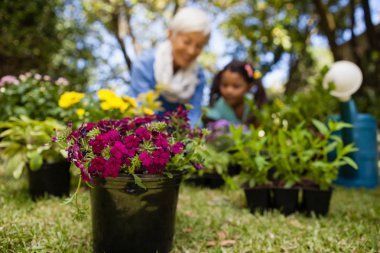
This demographic seems to thrive when given opportunities to “just be” in the present moment. I recently attained certification in Mindfulness-Based Stress Reduction (MBSR) and have been integrating mindfulness concepts into my HT sessions. The results have been significant. MBSR pairs well with plant-rich HT activity sessions, particularly sensory stimulation experiences. The combination of these two modalities provides a strong catalyst for individuals with dementia to notice and appreciate life as it is. This often leads to positive emotion and diminished agitation.
-
- Encourage Choice. Promoting choice for individuals with dementia is important. It helps to maintain their sense of autonomy, dignity, and control over their lives. Notably, people experiencing memory challenges need to be able to see choices in front of them, and then be encouraged to select the choice most suitable for them in the present moment.
For instance, during group sessions, I enjoy presenting four to five aromatic and tactile herbs individually, discussing each one sequentially, and then placing them in the center of the table for participants. After all the herbs are displayed, participants can choose which ones they would like to engage with. They can then incorporate these herbs into their seasonal plantings, and many participants become eager to talk about their choices with the group.
-
- Encourage Voice. Fostering communication for this demographic is equally important. It boosts quality of life, emotional well-being, sense of agency, and connection with others.
Communication with individuals impacted by dementia can be challenging. The disease can impair language skills, making it difficult for individuals to form words and sentences. Individuals might also be orientating to an earlier time in their lives, making it challenging to understand the content of what the participants are trying to communicate in the present moment.
Make extra effort to listen with curiosity and respond with kindness. Even if it is challenging to understand what the person is communicating, he/she deserves authentic attention and response, even if that means providing the person with a non-specific response to validate his/her communication. Demonstrating positive regard towards the individual and curiosity about what he/she is experiencing helps encourage the individual to share experiences and thoughts. This will lead to participants feeling understood and valued, impacting their overall experience and connection.
-
- Optimize the People-Plant Connection. Above all, harness the benefits that plants and plant-rich settings can offer this population group. Create a calming and nurturing environment that will reduce stress, anxiety, and agitation. Provide opportunities for participants to meaningfully engage with plants, triggering positive emotions and improving cognitive orientation and function. Generate sense of purpose and responsibility as participants care for plants and contribute to the maintenance of the green space. Above all, demonstrate a holistic approach to dementia care, addressing physical, emotional, cognitive and social needs, while also providing opportunities for joy, mindfulness, and connection.
About the author: Kelly Warnick, BA, JD, AAS Horticulture, Certificate in Horticultural Therapy. Kelly serves on the AHTA Board of Directors. She has just completed her Professional Registration Internship with the Chicago Botanic Garden and has submitted her application for HTR designation.
Works Cited
2024 Alzheimer’s disease facts and figures. (n.d.). https://www.alz.org/media/documents/alzheimers-facts-and-figures.pdf
Lokvig, J. F. (2014). The alzheimer’s creativity project: The caregiver’s ultimate guide to a good day. Endless Circle Press.
Vespa, J. (2021, October 8). Demographic turning points for the United States: Population projections for 2020 to 2060. Census.gov. https://www.census.gov/library/publications/2020/demo/p25-1144.html
Zhao, Y., Liu, Y., & Wang, Z. (2020). Effectiveness of horticultural therapy in people with dementia: A quantitative systematic review. Journal of Clinical Nursing, 31(13–14), 1983–1997. https://doi.org/10.1111/jocn.15204
HTI Kudos
Congratulations to HTI graduate Amy Zink who received a 2024 Woman of Distinction Award from the Mayor and San Diego City Council for her work on the Community Garden and efforts towards food sovereignty in San Diego. Amy is the program manager for the Bayside Environmental Learning Center She heads the streering committee for the Linda Vista Community Garden and is an urban farmer as well.
We are proud of you!