This blog was originally written in Chinese, and can be viewed in the original format here.
Healthy Aging
As we know, the average life expectancy of people with intellectual disabilities has gradually increased due to advances in medical care (International Association for the Scientific Study of Intellectual Disabilities [IASSID], 2002). However, compared with the general older adult population, there has been relatively limited discussion and research on how to promote “healthy ageing” among adults with intellectual disabilities. Accordingly, the World Health Organization (WHO), in collaboration with organizations such as the International Association for the Scientific Study of Intellectual Disabilities (IASSID) and Inclusion International (II), issued an action-strategy summary report—Ageing and Intellectual Disability: Improving Longevity and Promoting Healthy Aging (WHO, 2000)—to guide policy development and implementation across countries. This summary report indicates that results that could serve as evidence of the social value of serving people with intellectual disabilities may include:
- Practical, leisure, or life enhancing skills (such as those involved in self-determination and those which allow a person to access common opportunities offering enduring benefits);
- Improved or maintained dietary and general health status that prevents physical health factors from hindering typical activity;
- A varied rhythm of life
- Recognition that challenge and productivity must continue throughout old age;
- An increased and well-established social network; and
- Participation on a regular basis in the general life of the community, with friends and acquaintances of one’s preference.
The summary report also notes that supportive services should be adjusted according to the age of people with intellectual disabilities to reflect their distinct needs (WHO, 2000).
Health Promotion
The Nantou Education and Nursing Institution under Taiwan’s Ministry of Health and Welfare, as a facility serving individuals with severe and profound intellectual disabilities, reflects this international trend. As residents have experienced progressive physical and psychological ageing, the institution’s service focus has shifted from cultivating skills in the past toward strengthening leisure activities and health promotion. We (the author, a Taiwanese horticultural therapist, and an educational care worker at The Nantou Education and Nursing Institution) jointly planned a “Therapeutic garden” to support residents in maintaining physical and mental functioning and to promote healthy ageing through natural landscapes and functional facilities.
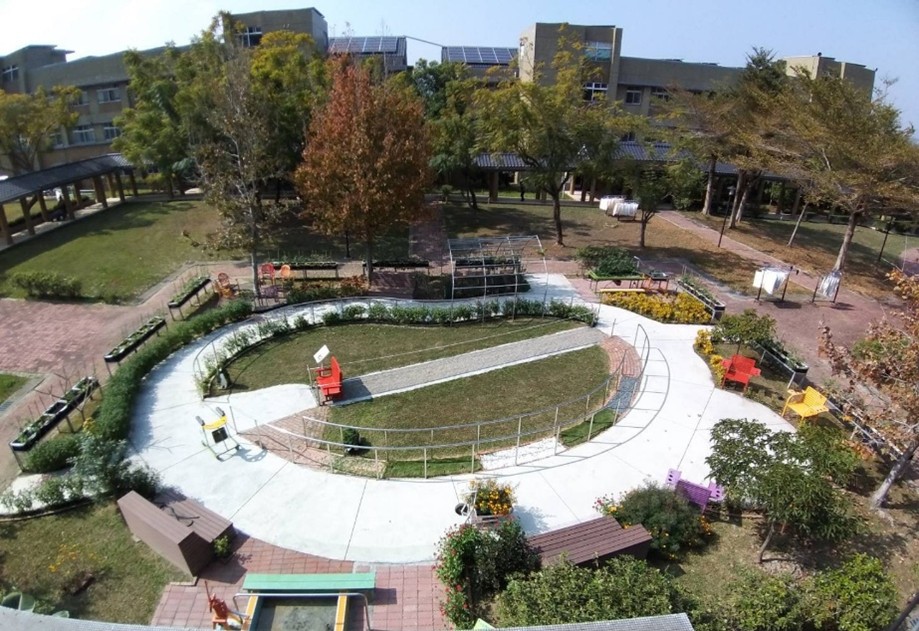
The Therapeutic garden at The Nantou Education and Nursing Institution covers approximately 21 × 18 square meters and is located in front of the residential dormitory. An aerial view of the entire garden is shown in Figure 1.
The garden is planted with a variety of herbs and butterfly- and bird-attracting plants to promote biodiversity and provide sensory stimulation. To encourage gradually ageing residents to visit the garden for recreational activities, we installed seven tailored facilities. The design concepts and functions of these seven facilities are as follows:
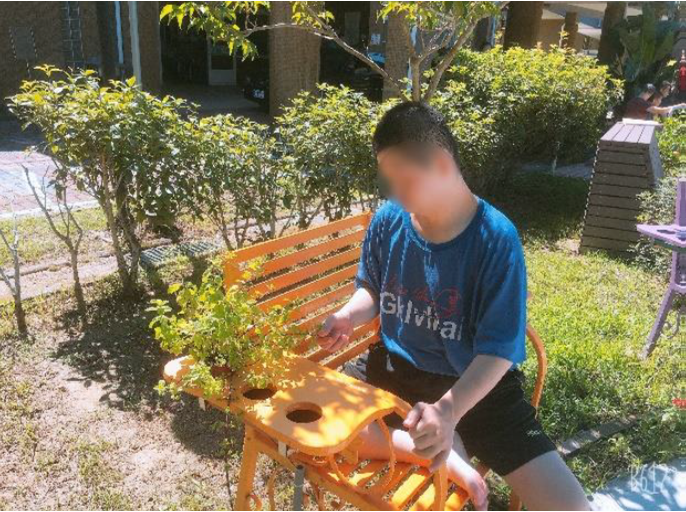
1. Olfactory Experience Bench
Description: Enables users to easily touch and smell the fragrance of plants while seated, allowing them to enjoy olfactory-based therapeutic benefits.
Functions: Provides olfactory stimulation; helps stabilize mood and relieve stress; increases opportunities for outdoor sunlight exposure, supporting vitamin D synthesis and preventing osteoporosis.
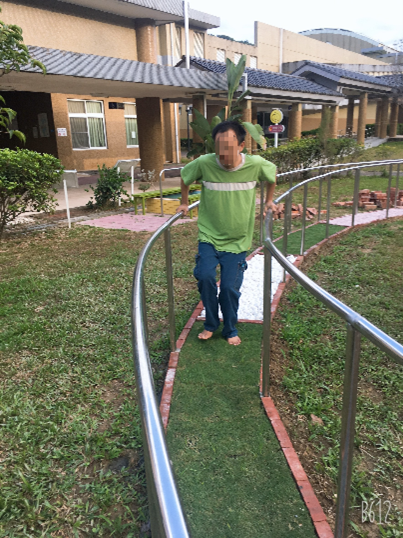
2. Tactile Walkway
Description: A walkway approximately 10 meters in length, constructed in segments using different natural materials such as turf, fine sand, and pebbles. When users walk barefoot, the variations in texture (e.g., coarseness and fineness) and firmness (e.g., softness and hardness) provide different forms of stimulation to the soles of the feet. Handrails are installed on both sides of the walkway to enhance safety for older users.
Functions: Stimulates and massages the soles of the feet; promotes peripheral blood circulation.
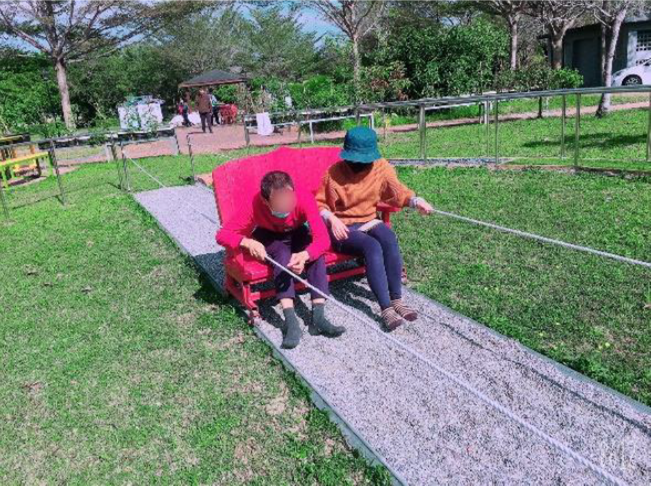
3. Lower-Limb Exercise Track Bench
Description: Tracks are installed along both sides of an approximately 10-meter walkway, with a custom-designed track seat placed on the rails. Individuals with weaker lower-limb strength (e.g., those who use a wheelchair in daily life but still have sensation in both feet) can sit on the track seat and use leg force to slide forward and backward (similar to a toddler walker), enabling the seat to move along the track either forward or in reverse.
Functions: Trains lower-limb muscle strength; stimulates plantar neural reflexes; increases opportunities for sunlight exposure; and allows wheelchair users with weaker lower-limb strength to experience the enjoyment of moving their legs freely.
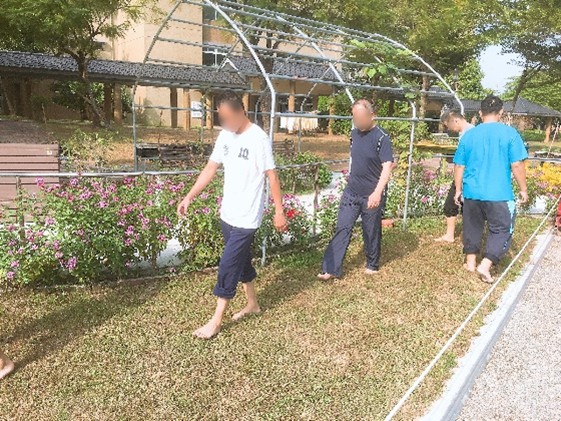
4. Grass Relaxation Area
Description: Encourages users to walk barefoot and lie down on the grass, connecting with the earth directly, smelling the scent of grass, and gazing up at the blue sky.
Functions: Provides a whole-body tactile experience; relaxes the eyes and muscles; and creates opportunities for social talking.
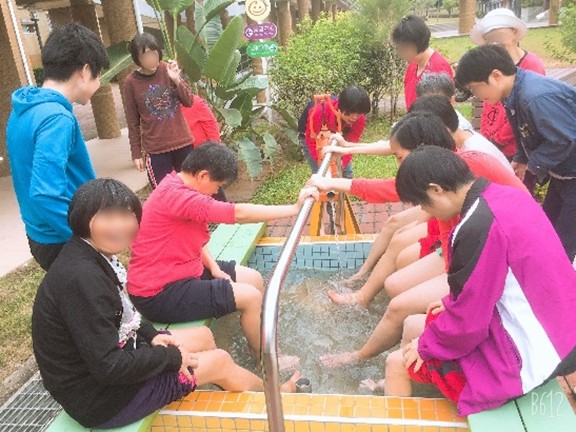
5. Hand-Pumped Foot Spa Facility
Description: Users must manually pump water before soaking their feet. Herbs or essential oils can be added to the water. The facility is suitable for multiple users at the same time.
Functions: The pumping action can enhance upper-limb muscle strength. The scent of essential oils or herbs can promote relaxation. Shared use by multiple individuals can enhance social interaction.
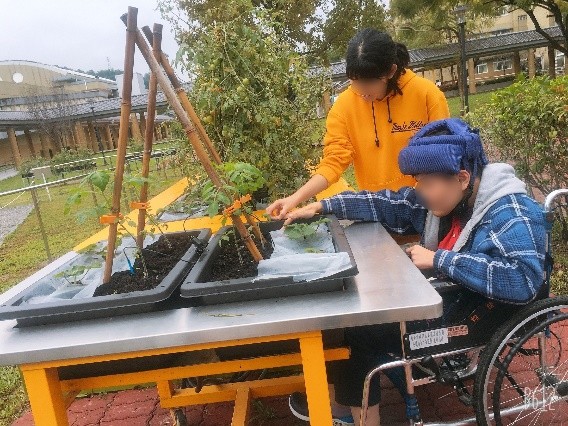
6. Raised Planting Beds
Description: Uses raised planting beds to enable older adults who use wheelchairs to engage in horticultural activities and to observe plant growth.
Functions: Enhances perceived control over the environment; promotes upper-limb activity, manual dexterity, time orientation (e.g., seasonal vegetables), and social interaction.
7. Walking Pathway and Walking Aids
Description: A walking pathway encircles the garden and is equipped with two specialized walking aids. The first resembles a small cart, with copper bells attached to the bottom to produce sound, and it can carry potted plants to increase pushing resistance. The second is a modified walker that can carry fragrant plants at the front.
Functions: Uses auditory and olfactory feedback to increase the enjoyment of walking and motivation to participate, while also training lower-limb muscular endurance.
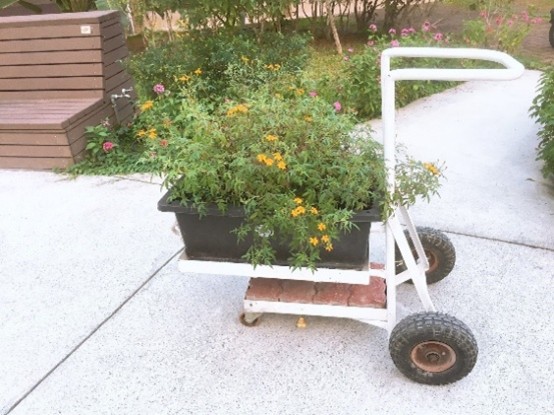

Walking aids with adjustable resistance (left) or carrying fragrant plants at the front (right). (Image source: Liao et al., 2021)
The design of the therapeutic garden at The Nantou Education and Nursing Institution concretely operationalizes the World Health Organization’s social value–based foundation for the care of older adults with intellectual disabilities. Through practical and fun facilities, the garden not only provides a healing space but also integrates rehabilitation training into daily life.
Within this garden, residents can experience sensory stimulation markedly different from that in indoor environments. Visual variations in color, auditory stimuli such as insect and bird sounds, tactile experiences with diverse materials, and plant fragrances together create a comprehensive therapeutic environment. These design elements not only help alleviate stress and reduce mental fatigue but also facilitate social interaction through activities such as soaking feet together, planting, or using the track bench.
In summary, in response to the global challenge of ageing among people with disabilities, the Therapeutic garden at The Nantou Education and Nursing Institution offers a successful model of practice. It demonstrates that a carefully designed environmental intervention can simultaneously meet the needs of older adults with intellectual disabilities in terms of physical health, cognitive maintenance, psychological relaxation, and social interaction, thereby achieving the goal of “healthy ageing.”
References:
International Association for the Scientific Study of Intellectual Disabilities. (2002). Aging and Intellectual Disabilities. IASSID Publishing.
Liao, M. L., Shih, F. L., Chen, Y. L., Chen, Y. J., & Chen, W. J. (2021). Recreational amenities for elderly people with intellectual disabilities: an introduction to the therapeutic garden at Nantou Education and Nursing Institute of the Ministry of Health and Welfare. Garden Quarterly 93, 52-62.
World Health Organization. (2000). Healthy ageing: adults with intellectual disabilities: Summative report. World Health Organization. https://www.who.int/publications/i/item/WHO-MSD-HPS-MDP-00.3