This blog was originally written in Spanish, and can be viewed in the original format here.
I see my professional development as a horticultural therapy practitioner as a never-ending process; I am never done training and learning. One of the main ways in which I pursue this goal is by reading widely. I find that encountering the experiences and insights of diverse scholars and practitioners is a powerful catalyst for reflection on my own practice. For example, some of the books that I share below have helped me reflect on how I can best accompany clients as they cultivate a bond with plants in their daily lives. I also find that as I equip myself with more evidence, I can speak with more passion and conviction and explain in greater detail why building a relationship with plants is so important for people’s wellbeing.
You will see that the list of books I share below is richly multidisciplinary. It includes perspectives from psychiatrists and psychologists, as well as neuroscientists, philosophers and ecologists. The work of psychiatrists and psychologists helps me understand which aspects of nature promote healing, philosophers guide my reflections on the spiritual dimensions of wellbeing and on the ethics of our relationship with the natural world, while neuroscientists help me understand how nature produces an impact on the brain and how these are measured. Each discipline offers a distinct lens, and together they shape a more complete foundation for practice.
The short selection of books below is therefore just a start, but I hope it supports colleagues and students as they pursue self-reflection and growth in their own practices.
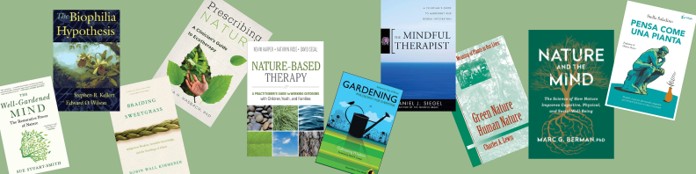
The Well-Gardened Mind by Sue Stuart-Smith
The Well-Gardened Mind by Sue Stuart-Smith explores the psychological and emotional connections between humans and nature. Building on her experience as both a psychiatrist and gardener, Stuart-Smith weaves together neuroscience and history to show how gardening can nurture mental health, resilience, and a sense of meaning. This book provides a framework for horticultural therapy practitioners because it helps us understand why working with plants can support healing. Stuart-Smith illustrates how gardening activities engage both body and mind simultaneously and thus highlights the value of horticultural therapy as a holistic approach to mental health care.
Nature and the Mind by Dr. Marc G. Berman
In Nature and the Mind, Dr. Marc Berman, a student and collaborator of Stephen Kaplan, investigates the powerful relationship between natural environments and human cognitive and emotional functioning. Drawing on research in psychology and neuroscience, Berman demonstrates how exposure to nature can restore attention, reduce mental fatigue, and improve overall wellbeing. His studies indicate that natural settings help replenish the brain’s capacity for directed attention, with measurable benefits for memory and mood. Berman explains how natural environments actively contribute to cognitive restoration and psychological health. This research reinforces the role of horticultural therapy as an evidence-based approach that can enhance mental health, rehabilitation, and quality of life.
Nature-Based Therapy by Nevin Harper, Kathryn Rose & David Segal
This book by Nevin Harper, Kathryn Rose and David Segal shows how nature can function as a co-therapist in the healing process. It encourages therapists to move beyond traditional indoor settings and engage clients in outdoor experiences that foster connection and emotional growth. In addition to providing a theoretical framework that underlies plant and nature-based interventions, the authors present practical methods, ethical considerations, and program designs for working therapeutically in natural spaces. The book provides guidance and conceptual support for practitioners who use gardens and plant-centered activities as therapeutic tools.
The Biophilia Hypothesis by Stephen R. Kellert & Edward O.Wilson
The Biophilia Hypothesis, edited by Stephen R. Kellert and Edward O. Wilson, was one of the first books I read at the start of my training. It is a foundational work centered on the idea that humans possess an innate tendency to seek connections with nature and other living systems. The authors and contributing scholars argue that this affinity for life, what Wilson calls “biophilia”, has deep evolutionary roots, developed through thousands of years of human interaction with natural environments. The book examines how this biological and psychological bond with nature influences human cognition and emotional health. The suggestion that humans are biologically predisposed to respond positively to natural environments helps us position and justify horticultural therapy as a necessary intervention to address the human need for connection with the living world.
Pensa come una pianta by Stella Saladino
When I read Stella Salladino’s book Pensa come una pianta, I said to myself “Finally, I found someone who thinks about plants as I do!” In her book, she invites readers to reconsider the way we perceive plants and the living world. Through a thoughtful and accessible narrative that blends scientific insights and philosophy, Saladino demonstrates the intelligence and interconnectedness of plants, encouraging a shift from viewing them as passive background elements to recognizing them as dynamic living beings. This book is worth reading because it fosters a deeper awareness of plants as active partners in the therapeutic process. By encouraging practitioners and participants to “think like a plant,” Saladino’s work promotes empathy, patience, and attentiveness, qualities that are central to therapeutic gardening activities. This perspective reminds us that engaging with plants is not only a practical activity but also a relational experience that can cultivate emotional connection and a renewed sense of belonging within the natural world.
Green Nature, Human Nature by Charles A. Lewis
Green Nature, Human Nature by Charles A. Lewis was perhaps the first book I read on this subject. It was introduced to me during my training in the USA with the HTI. This fantastic text explores the deep relationship between people and plants and the psychological and social benefits of interacting with nature. Combining examples from his own research and practice with historical perspectives, Lewis demonstrates how gardens and plant-centered activities can support human well-being and community connection. This book offers valuable insight into the theoretical foundations of people–plant relationships and provides a useful framework for understanding why horticultural activities can be powerful tools for rehabilitation and healing.
Gardening Philosophy for Everyone by Dan O’Brien
Gardening Philosophy for Everyone, edited by Dan O’Brien, draws out the deeper meanings and values found in the act of gardening through a collection of philosophical essays. The book examines themes such as patience, care, environmental ethics, and the human relationship with nature, encouraging readers to consider how gardening shapes our understanding of life and well-being. It has helped me deepen my practice through its perspective on the reflective and meaning-making aspects of working with plants, highlighting how gardening can foster personal growth, as well as deeper attention and connection with the natural world.
Prescribing Nature by Patricia H. Hasbach
In this book, Patricia H. Hasbach, a psychologist and Eco therapist, presents a compelling argument for integrating nature into clinical practice as a legitimate and effective therapeutic tool. Prescribing Nature blends clinical insights and practical guidance to show how engagement with natural environments can support emotional regulation and psychological healing. She focuses especially on the principles of ecotherapy and explores how clinicians can incorporate nature-based interventions to treat anxiety, depression, trauma, and burnout. Hasbach’s contribution is therefore particularly relevant to our practice, since it powerfully argues that horticultural therapy can function as a valuable adjunct to conventional treatments, offering participants a restorative, embodied pathway toward psychological wellbeing and recovery.
The Mindful Therapist by Daniel J. Siegel
In his book The Mindful Therapist, Daniel J. Siegel discusses how mindfulness and interpersonal neurobiology can deepen the therapeutic relationship and enhance clinical effectiveness. Siegel considers mindfulness as a technique to be cultivated by both therapists and clients. He argues that therapists who cultivate mindful awareness of their own internal states and their clients’ experiences are better able to foster integration and emotional regulation. Likewise, this perspective is particularly important within the broader framework of Third Generation Therapies, such as Mindfulness-Based Cognitive Therapy. Plant-based therapeutic activities naturally invite present-moment awareness and sensory engagement, which are core elements of mindfulness-based approaches. Horticultural therapy is thus well positioned to function as a context in which clients practice mindfulness through direct interaction with plants. Siegel’s book represents an important contribution to integrating mindfulness and nature-based practices. Moreover, its discussion of mindfulness as a self-care technique can fuel growing reflections on the topic of self-care among horticultural therapy practitioners, a conversation that has not received much attention yet within our field.
Braiding Sweetgrass by Robin Wall Kimmerer
Braiding Sweetgrass: Indigenous Wisdom, Scientific Knowledge, and the Teachings of Plants by Robin Wall Kimmerer is a beautiful text on the relationship between humans and the living world. As a botanist and member of the Citizen Potawatomi Nation, Kimmerer shows us how plants can serve as teachers of reciprocity, gratitude, and interconnectedness by weaving together Indigenous ecological knowledge, scientific understanding, and personal storytelling. Kimmerer’s reflections on species such as sweetgrass, maple, and moss encourage us to recognize the interrelationship between humans and plants, instead of viewing nature as an inert resource. This book emphasizes the relational dimension of working with plants, encouraging practitioners and participants to approach gardens not merely as therapeutic settings but as reciprocal spaces where attentiveness and respect for the more-than-human world can flourish.