By Margherita Volpini and Daniela Silva-Rodriguez Bonazzi
This blog was originally written in Spanish, and can be read in Spanish here.
After earning her degree in Education Sciences, Margherita began studying horticultural therapy 14 years ago at the Scuola Agraria del Parco di Monza. She later completed the specialist course in Therapeutic Landscape Design at the Politecnico di Milano, and the Master’s in Therapeutic Horticulture at the University of Bologna, and she will soon begin an advanced course in Biophilic Design. Over the years, she has also taken part in numerous continuing education programs on nature-based interventions.
When I first began introducing therapeutic horticulture at the Stradella Day Center for people with disabilities more than ten years ago, I never imagined how profoundly it would transform the lives of the people I meet every day, and my own. Orto Bubù was born this way: from the desire to create a space where nature could become a bridge to dignity, competence, presence, and self-determination. Not just a simple garden, but a laboratory of possibilities.
Horticultural therapy, as defined by the American Horticultural Therapy Association, is a rehabilitative practice based on standardized procedures, conducted by a trained professional, with the goal of achieving specific and documented therapeutic outcomes. In my daily work, this definition takes concrete form through activities designed for one person at a time, tailored to their goals, desires, values, and life plans. Putting the person at the center is the beating heart of everything I do: every activity becomes an opportunity to explore potential, build skills, and reclaim an active role.
Biophilia: The Theoretical Foundation Underpinning My Practice
Biophilia, “love of life,” as Erich Fromm defines it, is one of the cornerstones of my work. Edward O. Wilson speaks of our innate tendency to turn our attention toward living things. I see it every day: in the eyes of those who enter the garden and find calm, in the smile of someone who recognizes a plant, in the surprise of someone observing a sprout.
Connection is a deep human need. Trees, plants, and natural cycles speak to our emotional and cognitive dimensions, offering a sense of belonging and continuity. In working with people with disabilities and autism, however, biophilia isn’t always immediate: many people need a mediator. This is where my role comes in: to facilitate the encounter, support the building of a bond, and accompany the person in the transition from the passive state of being cared for to the active state of caring for others.
“When I’m here, I feel calm, as if the plants understand me,” one participant told me. “I like watching them grow; it makes me feel good”, added another participant, observing the calendula sprouts.
The development of biophilia produces measurable effects: renewed focus, emotional regulation, increased empathy, the development of perceptual and motor sensitivity, the promotion of self-esteem and self-efficacy, and stress reduction. Forming a relationship with other living beings allows one to regain a positive self-image, rich in resources and beauty.
The Relationship with Nature as a Path to Self-Determination
In my work, the relationship with nature becomes a source of opportunities. People are “lifted out” of a state of vulnerability and engaged in rewarding, mindful activities that restore their sense of competence, dignity, and purpose. Growing vegetables, flowers, and herbs; building insect shelters; creating natural arrangements—these are activities that allow people to experience the creation of something beautiful and useful, with visible results that benefit not only themselves but also others.
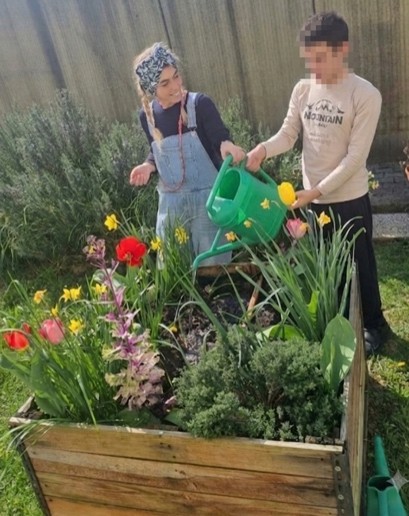
“When I take care of the plants, I feel important,” one participant told me as he arranged bamboo stakes. “I like it when others see what I’ve done,” added another, proudly showing off a decorated pot.
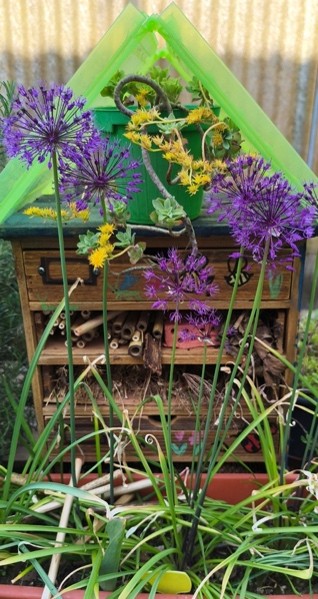
Among the most meaningful activities I offer, in addition to caring for plants, is building bird feeders or insect shelters: a task that requires precision, care, and attention to detail. The construction, choice of materials, decoration, and installation become moments of responsibility and pride. “This way, the birds come to visit us,” one participant told me, looking at the feeder hanging from a branch.
Another much-loved activity is the creation of garlands and mandalas, which combines fine motor skills, sensory stimulation, and creativity. Weaving natural materials, choosing decorative patterns, every gesture becomes an opportunity for self-expression. “It smells like a party,” said one participant, smiling as she showed off her creation.
Group Work and Individual Pathways
Every therapeutic program I design is personalized, based on each participant’s unique abilities, aspirations, and goals. This personalization maximizes the effectiveness of the intervention, promoting real and lasting personal growth. At the same time, therapeutic horticulture fosters teamwork: in the garden, we work together, each with a vital role, in an atmosphere of collaboration and inclusion.
“I like helping others carry the watering can, so the water doesn’t spill,” one participant told me. “When we work together, I feel like part of the group,” added another as we harvested sunflower seeds.
Nature becomes a form of self-expression, a springboard for a life plan and for genuine, achievable integration.
An Approach Centered on Potential
In my work, therapeutic horticulture shifts the focus from vulnerabilities to abilities. I do not focus on limitations or diagnoses but rather highlight strengths and potential.
“The goal is to shift the focus from loss to fulfillment, from loneliness to connection, from sadness to joy, from confusion to clarity, from frustration to peace of mind, from insecurity to confidence”
Haller, Kennedy, and Capra, 2019
A single activity can have different objectives: physical, cognitive, emotional, and social. Planting seeds, for example, is one of the most versatile activities I offer: it can support motor coordination, the ability to follow a sequence, managing anticipation, cooperation, and responsibility.
“I like planting seeds because then something I made grows,” a participant told me as he watched the first sprouts emerge. “Waiting for it to grow helps me stay calm,” added another participant.
Among the most symbolically rich activities is “Like a Tree,”in which I invite participants to observe, touch, and draw a tree, reflecting on the roots, trunk, branches, and leaves as metaphors for their own stories, resources, and connections. “My roots are strong,” one participant told me, pointing to his drawing.
The Methodology: The Process That Guides the Relationship
The methodology I have developed over the years is the framework that allows the relationship with nature to become therapy, growth, and possibility.
Getting to Know the Participant
Gathering initial information, sensory profile, list of interests, questionnaires, allows me to understand needs, preferences, sensitivities, and ways of relating. The sensory profile is a valuable tool: it helps me understand how a person perceives stimuli, which materials they prefer, and which smells or textures may support or hinder the relationship.
SMART Goals
The goals I define are Specific, Measurable, Achievable, Realistic, and Time-bound (SMART goals). This framework allows me to monitor progress, adapt activities, and document results in a clear and replicable way.
Choosing the Context for the Relationship with Plants
Each activity is designed for one person at a time, tailored to their goals, desires, and values. The selection of plants, materials, timing, and spaces is an integral part of the methodology.
One of the most adaptable activities is mulching, which I suggest working on motor skills, sequencing, responsibility, and soil care. “I like to cover the ground, so the plants stay warm,” one participant told me as he spread the straw.
Monitoring, Assessment, and Documentation
Assessment is ongoing: narrative observations, quantitative scales, logbooks, and activity sheets. Documenting means valuing the process, making visible what is often invisible.
“I like looking back at my journal because it helps me remember how good I am”
Participant, while flipping through the pages chronicling his journey
Review and Reorientation
The final evaluation allows us to understand the results achieved, the skills developed, and areas for improvement, and to redefine goals for the next period. It is a moment of reflection and renewal, which restores the person’s awareness of their own journey.
The Space: Orto Bubù and Giardino Profumo
The activities I offer take place in two complementary settings:
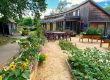
- Orto Bubù, the outdoor space, where we work with natural cycles, the seasons, and biodiversity.
- Giardino Profumo, the indoor space, dedicated to sensory experiences, aromatic plants, floral arrangements, and crafts.
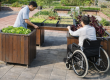
The design of the space is an integral part of the journey: a therapeutic garden-vegetable patch must be accessible, safe, stimulating, and rich in sensory and relational opportunities. The selection of plants follows specific criteria: safety, ease of handling, sensory value, observable growth cycles, and suitability for use in activities.
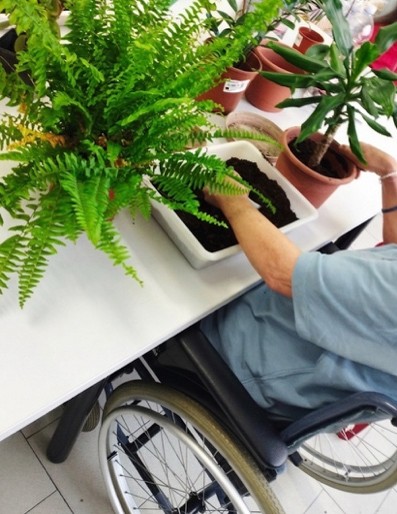
“The Giardino Profumo is my favorite place; I like to stroke the leaves of our ferns,” a participant told me as he stroked the fern in the classroom.
An Experience That Continues to Grow
The Orto Bubù experience is the result of years of work, field observations, adaptations, and ongoing evaluations. It is a journey that has demonstrated how a relationship with nature can restore dignity, competence, and presence right up to the end, as taught by Anna and Tina, who cherished the therapeutic horticulture sessions and left a legacy of beauty and tenderness.
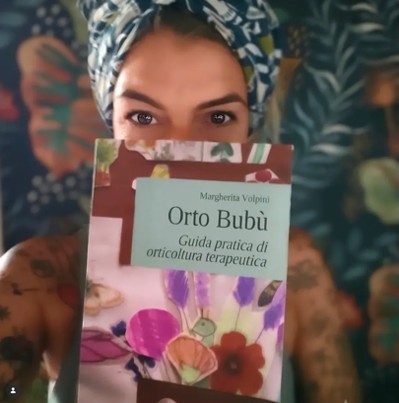
At the end of July, my book “Orto Bubù: A Practical Guide to Therapeutic Horticulture”, published by Edizioni Altravista, will be released. It compiles this experience and presents it as a practical resource for horticultural therapists, educators, and practitioners. It is the story of a journey that continues to blossom every day.
I am a therapeutic horticulturist, trainer, and program designer with a bachelor’s degree in education, a master’s degree in Therapeutic Horticulture, and specializations in Wellness Gardens and Therapeutic Landscape Design. For over twenty years, I have been working in educational, rehabilitative, and therapeutic settings, promoting physical, cognitive, psychological, and relational well-being through connection with nature.
I design, implement, and lead therapeutic horticulture programs for people with disabilities, autism, children and adolescents, and older adults, in both individual and group settings. I am involved in teaching, training, and research, and I design vegetable gardens, therapeutic gardens, and green spaces for rehabilitative, educational, and instructional purposes. I collaborate with organizations, universities, botanical gardens, hospitals, and schools to train professionals, develop nature-based projects, and lead therapeutic and inclusive activities.